Action firewall
Classify agent tool calls before execution: code writes, shell commands, external requests, CI/CD changes, deploys, and secret access.
SentinelMesh by Nuvetyx
Runtime security for autonomous coding, DevOps, and SRE agents.
SentinelMesh checks risky actions before agents access code, secrets, CI/CD, cloud infrastructure, or production systems.
Problem
Agents can now run commands, call APIs, and change code
Control point
Every risky action is checked before execution
Engineering surfaces
Repos, secrets, CI/CD, terminals, cloud, and production
Evidence
Approvals, blocked actions, and audit trails
Flagship product
AI guardrails often focus on prompts. SentinelMesh focuses on consequences. It sits between engineering agents and the tools they use, then allows, blocks, or approval-gates actions before they execute.
Classify agent tool calls before execution: code writes, shell commands, external requests, CI/CD changes, deploys, and secret access.
Pause high-risk actions until the right human reviews the request with source, destination, data, and blast-radius context.
Test agents against unsafe action scenarios before expanding their access to live engineering systems.
Example decision
Critical
The dangerous request is stopped, while safe engineering actions continue.
Agent
Payments coding agent
Requested action
Read a payment secret and send data to an unknown endpoint
SentinelMesh
Blocked before execution
Allowed next step
Run tests, write a branch, and open a pull request
Built for engineering agents
Start with coding agents, DevOps agents, SRE agents, CI/CD agents, and incident-response agents. Expand once action policies and approvals are trusted.
Book SentinelMesh demoHow it works
SentinelMesh is designed to fit between customer-hosted agents and the engineering systems those agents want to use.
Step 1
1
A coding or DevOps agent tries to call a tool, run a command, open a PR, modify CI/CD, or deploy.
Step 2
2
The action is mapped to a known category and checked against source, destination, data, environment, and agent role.
Step 3
3
Low-risk actions continue. Risky actions are blocked, sandboxed, observed, or sent for human approval.
Step 4
4
The action, decision, reason, and approval history are preserved for security and engineering review.
Use cases
SentinelMesh is focused on engineering agents first because they can change the systems your business runs on.
Let agents read code, run tests, and open pull requests while blocking secret access, protected-branch changes, and unsafe network calls.
Require approval before agents modify CI/CD, install packages, change deployment configuration, or trigger production-impacting workflows.
Control agents that inspect logs, propose mitigations, restart services, roll back changes, or interact with incident systems.
Put a security layer between agent clients and tool servers so high-risk tool calls can be reviewed before execution.
Auditability
Security teams need more than a blocked-action counter. SentinelMesh records what the agent tried to do, why the action was allowed or stopped, and what happened next.
Agent action record
A clear explanation for engineering and security review.
Requested action
The tool call, command, API request, destination, and resource being touched.
Risk context
Source, data class, environment, agent role, and whether the action matches the assigned goal.
Decision
Allow, block, observe, sandbox, redact, or require approval with a clear reason.
Audit trail
A replayable record for engineering, platform, and security review.
Enterprise control
SentinelMesh is built for teams moving from AI experiments to agent workflows that touch real engineering systems.
Control
Define what agents can read, write, execute, deploy, send, or escalate across engineering systems.
Control
Route high-risk actions to the right human before agents merge, deploy, modify CI/CD, or touch sensitive data.
Control
Review agent behavior through repos, tests, pull requests, incidents, CI/CD, terminals, secrets, and production systems.
Control
Start in observe mode, move high-risk actions to enforcement, and plan self-hosted enforcement for sensitive environments.
Also from Nuvetyx
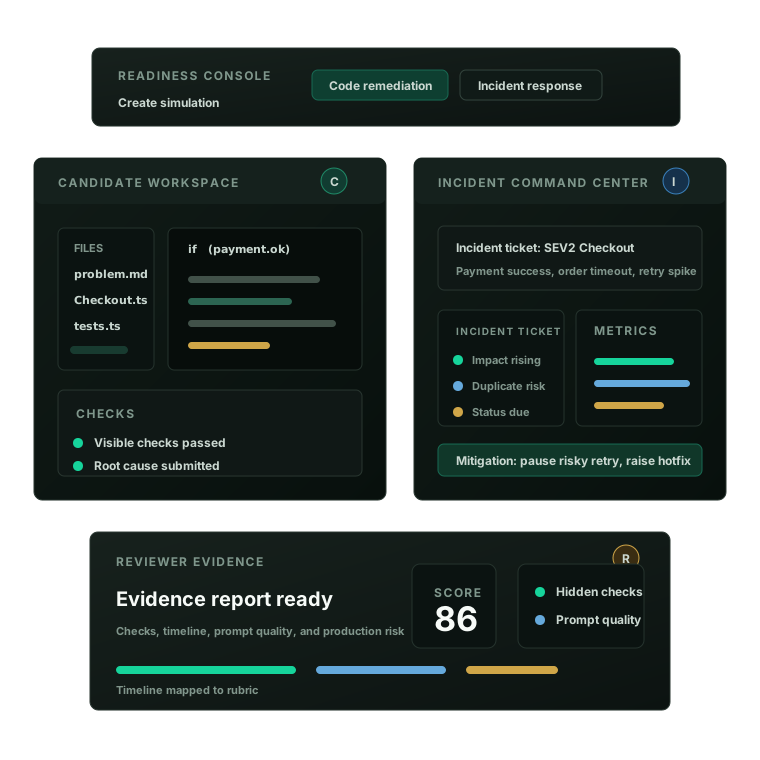
Evaluate how engineers use AI in realistic code, pull-request review, and incident-response simulations.
For hiring and internal readiness
Engineer Readiness is a separate product for assessing people. It does not compete with SentinelMesh on this page; it supports the broader Nuvetyx trust platform.
Explore Engineer ReadinessReady to control agent actions?
Walk through how SentinelMesh blocks unsafe actions, routes approvals, and preserves evidence for security review.